
FitSpresso Ingredients: Label, Doses and the Science Behind Each One
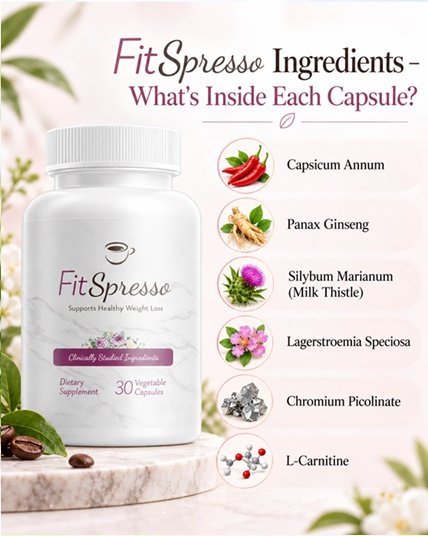
Summary: each 2-capsule serving of FitSpresso lists six main ingredients with disclosed amounts: chromium (1,000 mcg), alpha lipoic acid (150 mg), green tea extract (150 mg), berberine (100 mg), resveratrol (40 mg) and zinc (11 mg). Five more, including milk thistle, cayenne, ginseng, banaba and L-carnitine, share a 112 mg proprietary blend. Chromium is dosed at a research level; most of the others are below the amounts used in weight studies.
The FitSpresso Supplement Facts Label
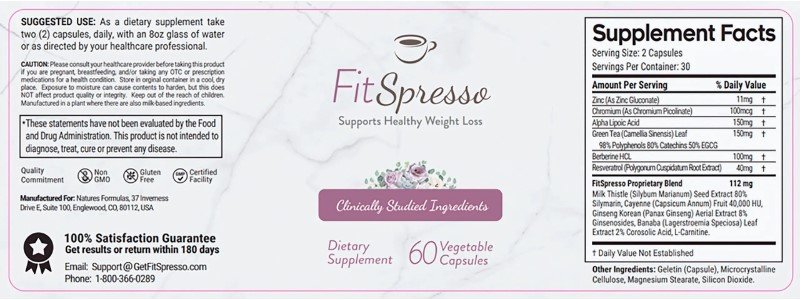
| Per serving (2 capsules) | Amount |
|---|---|
| Zinc (as zinc gluconate) | 11 mg |
| Chromium (as chromium picolinate) | 1,000 mcg |
| Alpha lipoic acid | 150 mg |
| Green tea (Camellia sinensis) leaf extract – 98% polyphenols, 80% catechins, 55% EGCG | 150 mg |
| Berberine HCl | 100 mg |
| Resveratrol (Polygonum cuspidatum root extract) | 40 mg |
| FitSpresso Proprietary Blend: milk thistle seed extract (80% silymarin), cayenne fruit (40,000 H.U.), Korean ginseng aerial extract (8% ginsenosides), banaba leaf extract (2% corosolic acid), L-carnitine | 112 mg total |
- Serving size
- 2 capsules
- Servings per bottle
- 30 (60 capsules)
- Suggested use
- 2 capsules daily with 8 oz of water
- Other ingredients
- Gelatin (capsule), microcrystalline cellulose, magnesium stearate, silicon dioxide
- Manufacturer on label
- Nature's Formulas, Englewood, CO, USA
FitSpresso Label Doses vs Research Doses
This is the most useful table on the page. It shows whether a serving of FitSpresso contains the amounts that were actually tested in weight-related studies.
| Ingredient | In FitSpresso | Typical research dose | Match? | Evidence (weight) |
|---|---|---|---|---|
| Chromium picolinate | 1,000 mcg | 200–1,000 mcg/day | Yes (upper end) | Strong |
| Alpha lipoic acid | 150 mg | Usually 300–1,800 mg/day | Below | Strong |
| Green tea extract (≈83 mg EGCG) | 150 mg | Often several hundred mg of catechins/day | Below | Moderate |
| Berberine HCl | 100 mg | Usually 500–1,500 mg/day | Well below | Moderate |
| Resveratrol | 40 mg | Varies widely; many trials used more | Probably below | Moderate |
| Zinc | 11 mg | Daily Value is 11 mg | Nutritional dose | Limited |
| L-carnitine (in blend) | Part of 112 mg | 1,000–3,000 mg/day | Far below | Strong |
| Milk thistle, cayenne, ginseng, banaba (in blend) | Share of 112 mg | Typically 100s of mg each | Below | Moderate |
In short: chromium and zinc are clearly dosed, alpha lipoic acid and green tea are present at partial doses, and berberine and everything in the blend are at small fractions of the amounts studied.
The Six Main FitSpresso Ingredients
1. Chromium Picolinate – 1,000 mcg
What it is: a form of chromium, a trace mineral that helps insulin move glucose into cells.
Research: a 2013 meta-analysis found about 0.5 kg greater weight loss than placebo, a difference the authors considered of uncertain clinical relevance. Some studies suggest it may reduce carbohydrate cravings.
In FitSpresso: 1,000 mcg sits at the top of the studied range, so this is the most fully dosed ingredient.
Caution: may add to the effect of insulin and diabetes medicines; may reduce absorption of thyroid medication if taken at the same time.
2. Alpha Lipoic Acid – 150 mg
What it is: an antioxidant the body makes and uses in energy production in mitochondria.
Research: a 2017 meta-analysis of randomized trials found alpha lipoic acid produced about 1.3 kg more weight loss than placebo, a small but significant short-term effect.
In FitSpresso: 150 mg is lower than the doses commonly used in those trials, so a smaller effect is likely.
Caution: may lower blood sugar; occasional nausea or skin rash.
3. Green Tea Extract – 150 mg (≈83 mg EGCG)
What it is: a concentrated extract of green tea leaves, rich in catechins such as EGCG.
Research: a Cochrane review found green tea preparations led to small weight losses in overweight adults that were unlikely to be clinically important.
In FitSpresso: the amount is similar to one or two strong cups of green tea. The label does not say it is decaffeinated, so it may add a little caffeine on top of your coffee.
Caution: high-dose green tea extracts have been linked to rare liver injury, usually at much higher amounts and on an empty stomach.
4. Berberine HCl – 100 mg
What it is: a yellow plant compound found in barberry, goldenseal and other plants, widely studied for blood sugar and cholesterol.
Research: meta-analyses report small reductions in body weight and BMI, mostly in trials giving 500 mg or more, two to three times a day.
In FitSpresso: 100 mg per day is a fraction of those doses.
Caution: constipation or diarrhea; may add to diabetes medicines and interact with drugs broken down by liver enzymes (for example cyclosporine). Not for pregnancy or breastfeeding.
5. Resveratrol – 40 mg
What it is: a polyphenol found in grapes and Japanese knotweed (Polygonum cuspidatum), the source used here.
Research: a 2020 meta-analysis of 36 randomized trials found a statistically significant but small reduction in body weight and BMI, with larger effects in people with obesity and wide variation between studies.
Caution: may increase bleeding risk with blood thinners.
6. Zinc – 11 mg
What it is: an essential mineral involved in immunity, wound healing and insulin storage.
Research: correcting a deficiency matters for health, but there is no good evidence that zinc causes weight loss in people who are not deficient.
In FitSpresso: 11 mg equals 100% of the Daily Value, well below the 40 mg upper limit. If you also take a multivitamin, check your total zinc intake.
Caution: can reduce absorption of some antibiotics (tetracyclines, quinolones) if taken together.
The 112 mg FitSpresso Proprietary Blend
Five ingredients share a combined 112 mg, and the label does not show how much of each is included. For context, a single typical capsule of L-carnitine alone contains 500 mg.
| Blend ingredient | Standardization on label | What it is studied for |
|---|---|---|
| Milk thistle seed extract | 80% silymarin | Liver health; no good weight-loss evidence |
| Cayenne (Capsicum annuum) fruit | 40,000 heat units | Small increases in energy use and fullness |
| Korean ginseng (Panax ginseng) aerial extract | 8% ginsenosides | Energy and blood sugar; weak weight evidence. Note: made from aerial parts, not the more commonly studied root. |
| Banaba leaf extract | 2% corosolic acid | Blood sugar after meals; thin weight evidence |
| L-carnitine | Not stated | Fat transport; ~1.3 kg extra loss at 1–3 g/day in trials |
Because the whole blend weighs about as much as a quarter of a typical L-carnitine dose, each of these ingredients is present only in small amounts. They are unlikely to add much beyond the main ingredients.
Other Ingredients and the Capsule
- Gelatin capsule: gelatin is made from animal collagen. The front of the bottle describes 60 vegetable capsules, but the Supplement Facts panel lists gelatin as the capsule material. Until the seller clarifies, vegetarians and vegans should assume the capsules are not plant-based.
- Microcrystalline cellulose: a plant-fiber filler.
- Magnesium stearate and silicon dioxide: flow agents used in capsule manufacturing, considered safe at these amounts.
What Is Not in FitSpresso
- Coffee: despite the name, there is no coffee in the capsules.
- Added caffeine: none is listed, though green tea extract may contain a small amount naturally.
- Prescription drugs: none listed. Buy only from the genuine seller to avoid counterfeit products.
Bottom Line on FitSpresso Ingredients
The label is more transparent than many weight-loss products: six ingredients are listed with exact amounts. Chromium is dosed at a research level, and alpha lipoic acid, green tea and resveratrol add partial doses of ingredients with small, real effects in trials. Berberine and the blend ingredients are present in amounts too low to expect much. Overall, a small effect at most is a realistic expectation.
If you take medication, especially for diabetes, blood thinning or thyroid conditions, read FitSpresso side effects first. For the full verdict, see our FitSpresso reviews.
FitSpresso Ingredients FAQ
What are the main FitSpresso ingredients?
Chromium, alpha lipoic acid, green tea extract, berberine, resveratrol and zinc, plus a 112 mg blend of milk thistle, cayenne, ginseng, banaba and L-carnitine.
Does FitSpresso contain caffeine?
No caffeine is listed. The green tea extract may contain a small natural amount, and the coffee you take it with adds more.
Is FitSpresso vegetarian?
The Supplement Facts panel lists a gelatin capsule, which is animal-derived. Check your bottle.
How much berberine is in FitSpresso?
100 mg per serving, much less than the 500–1,500 mg used in most berberine studies.
Is 1,000 mcg of chromium safe?
Doses up to 1,000 mcg per day have been used in studies without serious problems in healthy adults. People with kidney or liver disease or on diabetes medication should ask a doctor first.
References
- Onakpoya I, Posadzki P, Ernst E. The efficacy of chromium supplementation on body weight: a systematic review and meta-analysis. Obesity Reviews. 2013;14(6):496–507.
- Kucukgoncu S, Zhou E, Lucas KB, Tek C. Alpha-lipoic acid (ALA) as a supplementation for weight loss: results from a meta-analysis of randomized controlled trials. Obesity Reviews. 2017;18(5):594–601.
- Jurgens TM, Whelan AM, Killian L, et al. Green tea for weight loss and weight maintenance in overweight or obese adults. Cochrane Database of Systematic Reviews. 2012;(12):CD008650.
- Xiong P, Niu L, Talaei S, et al. The effect of berberine supplementation on obesity indices: a dose–response meta-analysis and systematic review of randomized controlled trials. Complementary Therapies in Clinical Practice. 2020;39:101113.
- Tabrizi R, Tamtaji OR, Lankarani KB, et al. The effects of resveratrol intake on weight loss: a systematic review and meta-analysis of randomized controlled trials. Critical Reviews in Food Science and Nutrition. 2020;60(3):375–390.
- Pooyandjoo M, et al. The effect of (L-)carnitine on weight loss in adults: a systematic review and meta-analysis. Obesity Reviews. 2016;17(10):970–976.
- NIH ODS. Chromium fact sheet. ods.od.nih.gov
- NIH ODS. Zinc fact sheet. ods.od.nih.gov
- NCCIH. Green Tea. nccih.nih.gov
- NIH ODS. Dietary Supplements for Weight Loss. ods.od.nih.gov